5-Axis Programs
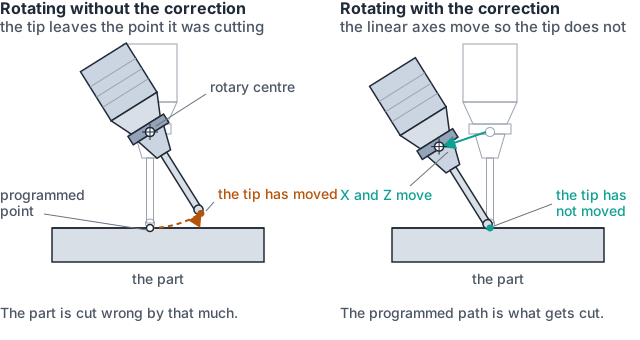
Once the rotary axes move during a cut, the tool tip and the machine’s position registers part company: tilt the head five degrees and the tip swings through an arc while every axis still reads what it was told. Tool centre point control is the mode where you program the tip, and the control works out what the machine has to do to keep it there.
Turning it on
Section titled “Turning it on”| Code | What it does | What it needs |
|---|---|---|
G43.4 | The rotary axis angles in the block decide where the tool points. | The tool’s offset number, H |
G43.5 | You give the tool direction as a vector and the control resolves the angles. | H, and the vector in I J K |
G43.8 | Compensation along the tool direction. | The tool’s offset number, H |
G43.9 | Keeps the mode across MDI blocks. | |
G49 | Cancels it. |
These share one modal group with G43, so exactly one of them is active at a time and the
last one in the block wins. There is no state where plain G43 and G43.4 both apply.
A block that turns the mode on without an offset number is rejected. G43.4 and
G43.5 carry the tool length into every interpolation cycle, so the control will not start
without knowing which tool it is holding.
What the feed means
Section titled “What the feed means”The path is planned at the tool tip, so F is the speed of the tip, not of the flange or
of any one axis. Where the rotaries swing hard the machine works hard, and the tip still
travels at the feed you asked for.
A mode change costs a stop
Section titled “A mode change costs a stop”Turning the mode on or off, and changing the active tool length while it is on, empties the look-ahead before the next block starts. The machine comes to a stop at that block, whatever the block before it was doing.
That is not a fault, but it does decide where these codes belong in a program. Put
G43.4 and G49 in a retract or an approach, never in the middle of a finishing pass:
a stop in the cut leaves a mark.
Tool length is measured, not estimated
Section titled “Tool length is measured, not estimated”With plain G43 the length is added once and an error in it moves the tool in Z. Under
tool centre point control the length is used on every cycle to work out where the flange
must be, so an error in it moves the tip in every axis and changes with every degree
of tilt. A tool measured to the nearest hundredth is not good enough here.
What it does not do
Section titled “What it does not do”- It does not correct the machine’s geometry. The rotary centres it swings about come from the machine’s own measured data. If those are wrong, the tip is wrong, and no amount of tool centre point control finds it. That is what Volumetric Compensation is for.
- It does not remove the singularity. Where the tool axis lines up with a rotary axis, a small move of the tip needs a large swing of the rotary, and the machine slows to keep within its own limits. The kinematics of the machine decide that, not the control.
- It is a licensed option. Without it the control refuses the block rather than running
it as if the rotaries were not there, and says which option is missing:
Option not licensed: rotary tool center point control (G43.4/.5/.8/.9). The tilted working plane,G68.2withG53.1, is a separate option with its own message.
Where to go next
Section titled “Where to go next”- Tilted Working Plane: programming a face that is not square to the table.
- Tool & Work Offsets: where the tool length comes from.
- G & M Code List: the codes in this table beside the rest.